
HubSpot vs. Salesforce: Choosing the Right CRM for Your Business Needs
1/2/20262 min read
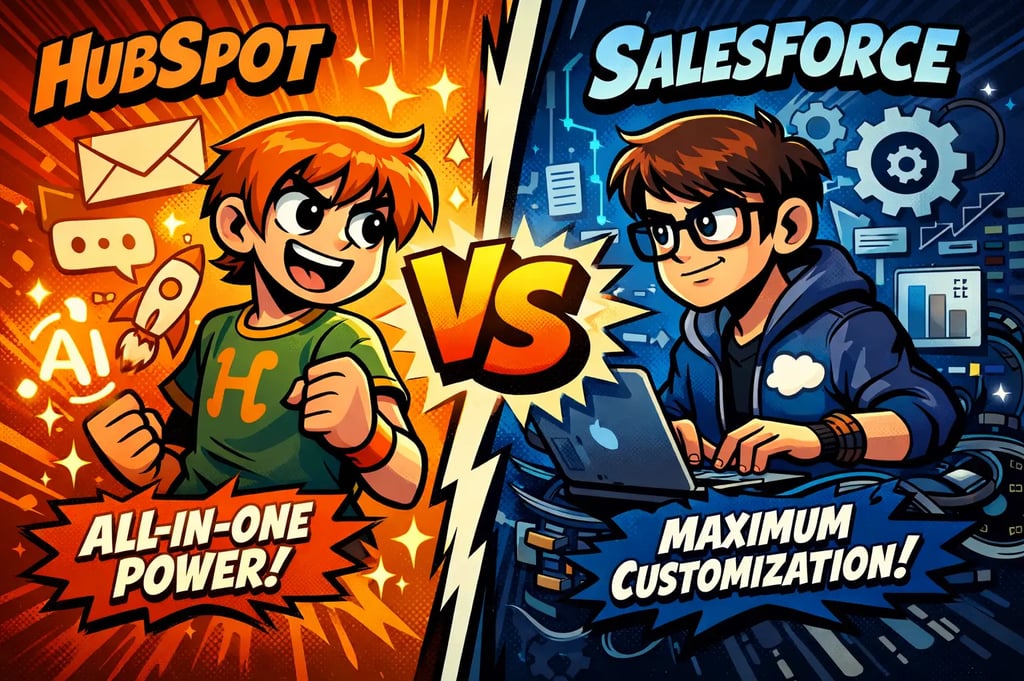
Hubspot Vs Salesforce
HubSpot vs. Salesforce: Which CRM Fits Your Business?
Choosing between HubSpot and Salesforce depends on your team size, technical resources, and goals. But for most businesses today, HubSpot offers more value, faster results, and less friction across the board. ✨
📈 Sales Reporting & Forecasting
HubSpot: Delivers powerful, real-time dashboards and customizable forecasting tools. Even mid-tier plans offer robust analytics with an intuitive interface. Sales leaders can track performance instantly without needing a data team. 💼
Salesforce: Deep reporting capabilities but often locked behind complex setup and higher-tier plans. Better suited for companies with technical administrators and time to invest.
🎯 Marketing Features
HubSpot: Originally built for marketing, HubSpot outpaces Salesforce here. It includes email, social, SEO, PPC, blogging, and automation tools all under one roof. Even its free and starter tiers offer serious functionality. 📬
Salesforce: Requires expensive add-ons like Marketing Cloud to match HubSpot's native features. Setup is often siloed and more difficult to align across teams.
🟨 Highlight: HubSpot gives you marketing superpowers from day one—without needing extra tools or teams.
🧠 Ease of Use & Onboarding
HubSpot: Designed for usability. Teams can get started quickly without developers or consultants. The platform offers guided setup, clean navigation, and clear feature accessibility. 🧭
Salesforce: Steep learning curve and segmented UI. Often requires onboarding support, system integrators, and longer ramp-up time to become effective.
🔧 Customization & Flexibility
HubSpot: Combines flexibility with simplicity. Users can build workflows, automation, custom objects, and integrations without writing code. Power users can go further with scripting and GitHub integrations. 🛠️
Salesforce: Offers deep customization but at the cost of complexity. Great for very large orgs with full-time admins or developers, but overkill for most SMBs and mid-market teams.
🤖 AI Capabilities
HubSpot: Breeze AI is built-in, fast, and intuitive. From content generation to sales insights and data enrichment, HubSpot’s AI works out-of-the-box with no setup required. 💡
Salesforce: Einstein AI is powerful but requires configuration and is tier-dependent. More of a toolkit than a solution for teams looking for fast wins.
🟨 Highlight: HubSpot’s AI is plug-and-play—perfect for teams that want smarter tools without the setup hassle.
💵 Pricing Overview
HubSpot: Transparent pricing with a generous free tier and cost-effective bundles. Plans scale by need, not complexity. No hidden fees or forced add-ons. ✅
Salesforce: Modular pricing can balloon quickly. Add-ons for basic functions are common. Requires annual contracts and can introduce surprise costs during growth.
🏁 Why HubSpot is the Better Choice
🔥 HubSpot delivers more out-of-the-box: CRM, marketing automation, AI, sales enablement, content tools, and service features all in one ecosystem.
🚀 Onboarding is fast. Adoption is high. Support is strong.
📈 Teams see ROI faster with fewer resources.
🧩 It scales from startup to enterprise without needing to replatform.
🟨 Unless you have highly unique workflows and a team dedicated to maintaining a complex system, HubSpot is the clear choice. It provides enterprise-grade functionality with a user-first experience—no layers of consultants, no heavy IT lift, just results.

Contact
info@techupdateguide.com
© 2025. All rights reserved.